
Choose a movable rug from the sofa and table, not from the floor area
For a movable area rug, the useful measurement is the furniture group and the space around it — the sofa, the tables, the door openings and the routes people use — not the floor area of the room.
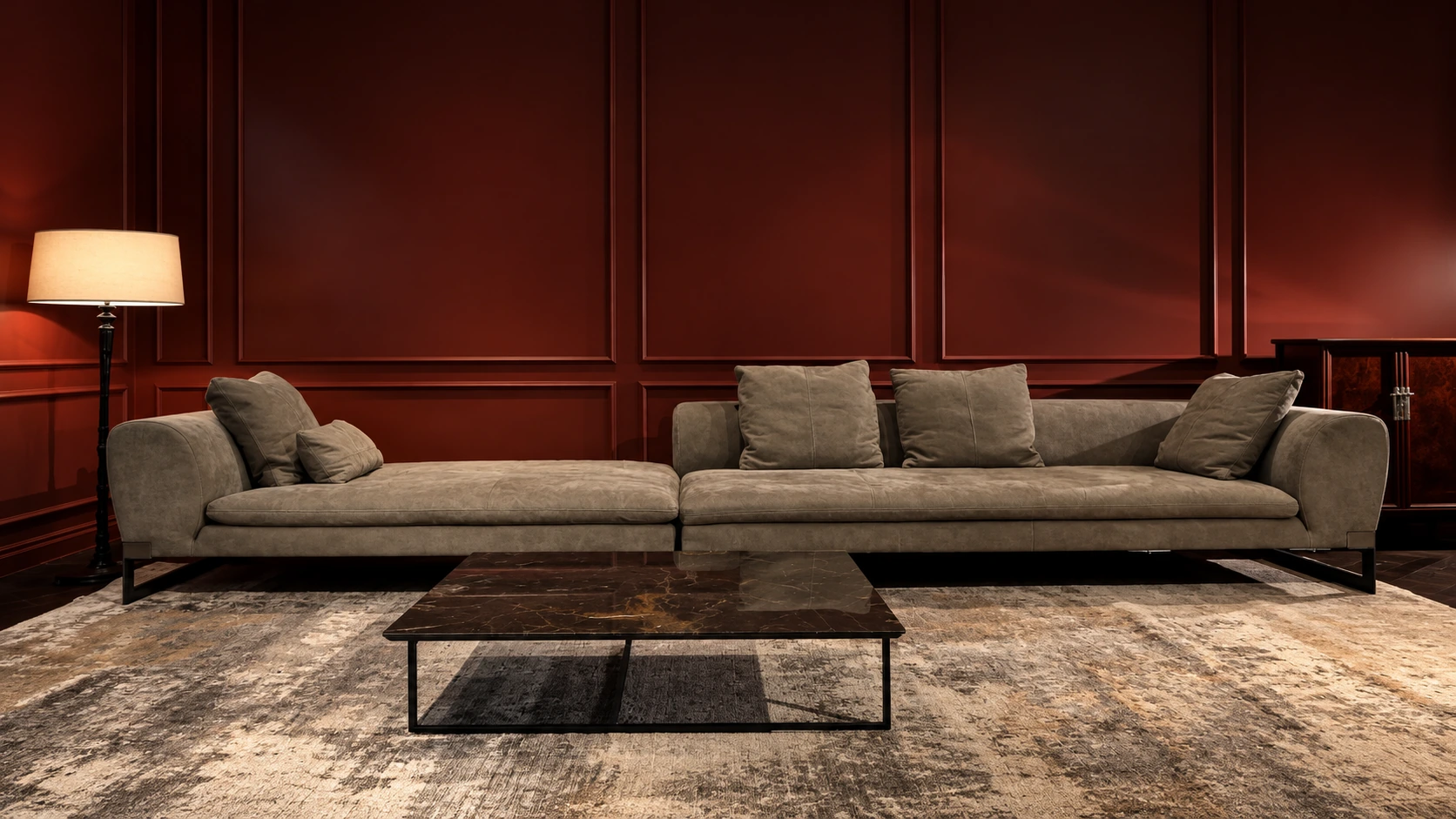
Start with the furniture group, not the floor area
For a movable area rug, the useful measurement is the furniture group and the space around it — the sofa, the tables, the door openings and the routes people use — not the floor area of the room. Mark those pieces first, decide which parts of the floor the rug should gather together, then test a paper outline, including the height of a pad or underlay, before confirming a size.
No single width or length is the right answer for every living room. The same sofa can support a smaller outline that takes only the front legs, or a larger one that carries the whole group. The job of this page is to give a measuring sequence and a set of checks, not a universal size chart.
A measuring sequence you can follow in the room
Measure the full extent of the furniture the rug will serve, including the depth of sofas and chairs as they actually sit, and the space between them. On a new plan, use confirmed furniture dimensions rather than an estimate. Add the space needed to pull a dining chair out or to walk around a table. Note fixed elements that interrupt the group, such as a column or a radiator.
Then mark the routes to doors, windows and neighbouring areas, and the swing of every door that opens across the proposed outline. In an open room, decide whether one rug should gather the main sofa group, or whether a reading corner needs a separate, smaller piece. The outline should make the arrangement legible while leaving comfortable circulation.
Front legs, all legs, or a rug set clear of the furniture
There is no single correct rule for whether the front legs of a sofa should sit on the rug. Try a layout with only the front legs of the main seating on the rug, then compare a larger outline that carries the whole group. A smaller rug set clear of the furniture, often under a table only, creates a third relationship. All legs on the rug gives a contained seating island. Front legs on the rug keeps the piece smaller and leaves the back of the furniture on the floor finish. Either can be right. Write down which arrangement the layout uses, so the size follows a decision rather than an estimate.
A paper outline is especially useful for a round or irregular shape, where a width and a length alone say little about the space left around it. Walk the outline during ordinary use, and look at it from the main entrance, before anyone confirms finished dimensions.
Door clearance once a pad is added
A movable rug is rarely used without a backing or underlay. Once that pad is in place, the surface sits higher than the textile alone, and a door that cleared the bare floor may no longer clear the edge of the rug. Test the outline with the intended pad, or allow for its thickness, then open every door that swings over it. Check the routes people actually take. If the outline crowds a walkway or catches a door, adjust the size before ordering.
The same check belongs with any later move. When a familiar rug goes to another setting, review its condition, the new floor, and the appropriate underlay or backing. Note the approved position relative to a fixed point such as a wall or a door frame, and record which way the pile or pattern runs, so the piece can be put back without measuring again from memory.
A short measuring page devoted to the pad, the door swing and walking clearance is published as measure the pad, the door swing and the walking clearance before you order. Use it with this furniture-group note before placing an order. It does not give a universal inch or centimetre size, and it does not publish a standard pad thickness.
When a movable rug is a better choice than wall-to-wall carpet
A movable rug is usually the better choice when the furniture may change, when the piece should gather a group without covering the whole floor, or when it may later be lifted, rotated or moved to another room. Keep the brief open to that change: if a chair moves to the window or a table extends, the outline should still make sense.
A short contrast page devoted to that choice — starting from a changing furniture plan, a rental or a reconfigurable room — is published as when a movable rug is a better choice than wall-to-wall because the layout will change.
If the project instead needs a fixed, wall-to-wall or installed floor — a hotel corridor, a workplace plate, or another specification that will be sent to a mill — use the hotel and workplace specification brief on adacarpet.com. That is a different brief, written for zone, fibre, construction, dye lot and documents, not for furniture layout.
Dining furniture, outdoor weaves and the light in the room
Under a dining table, measure the table and the chairs together, and include the space needed to pull a chair out. Test that larger outline on the floor. The same sequence applies on a terrace or in a transitional space, with one additional caution: outdoor woven rugs are a separate case. The outdoor catalogue does not establish universal weatherproofing, and it does not make an indoor rug interchangeable with an outdoor one. A covered terrace, an open balcony and a living room are three different exposures. Describe sun, shelter and cleaning arrangements, then confirm the selected weave, backing and intended setting before ordering.
Colour should be checked in the actual room. Read a material sample beside the upholstery in daylight and in evening light. A photograph or a screen colour is a useful direction, but lighting, scale and pile change the finished surface. Finish with a physical sample, an agreed specification and care guidance for the selected fibre.
Care, and when to brief a handmade piece instead
Choose the fibre and finish with the actual use in mind, then follow the care instructions for that rug. A quiet bedroom and a busy route through a living space may lead to different priorities. Read the fibre and backing on the individual record; two rugs in the same collection direction can differ. Ask for handling and storage guidance for the approved construction before lifting or storing the piece.
If the piece you want is a handmade or hand-finished commission — fibre, carved or loop surfaces, and a brief to send before sampling — use adahandmade.com. This page stays with movable size, placement, pads and care. It is not a tutorial in how to tell a handmade rug from a machine-made one, and it is not a hospitality corridor specification.
What to send, and where to review it
Send a room plan, the dimensions of the main furniture, and two or three photographs that show the floor and the light. Mark door swings and the routes people use. If the furniture may change, describe the likely alternatives as well as the current layout. Note the preferred colour direction and the floor material. ADA can then compare size, fibre and edge options, and arrange a physical sample before the specification is agreed.
Write to adafloor@163.com or call +86 158 1876 6066. ADARUG is the ADA destination for movable area rugs. The Shenzhen showroom is at Room 2005, Phase II, Yizhan Centre, Zhanyi Road, Luohu; the Shanghai showroom is at 3F Wutongli, 3 Kangping Road, Xuhui. The hand-tufting workshop is in Xiqiao, Nanhai, Foshan. Visits are by appointment; please contact the studio before travelling.
Bring the plan, furniture dimensions and photographs to the conversation.
Discuss a rug with ADA ↗